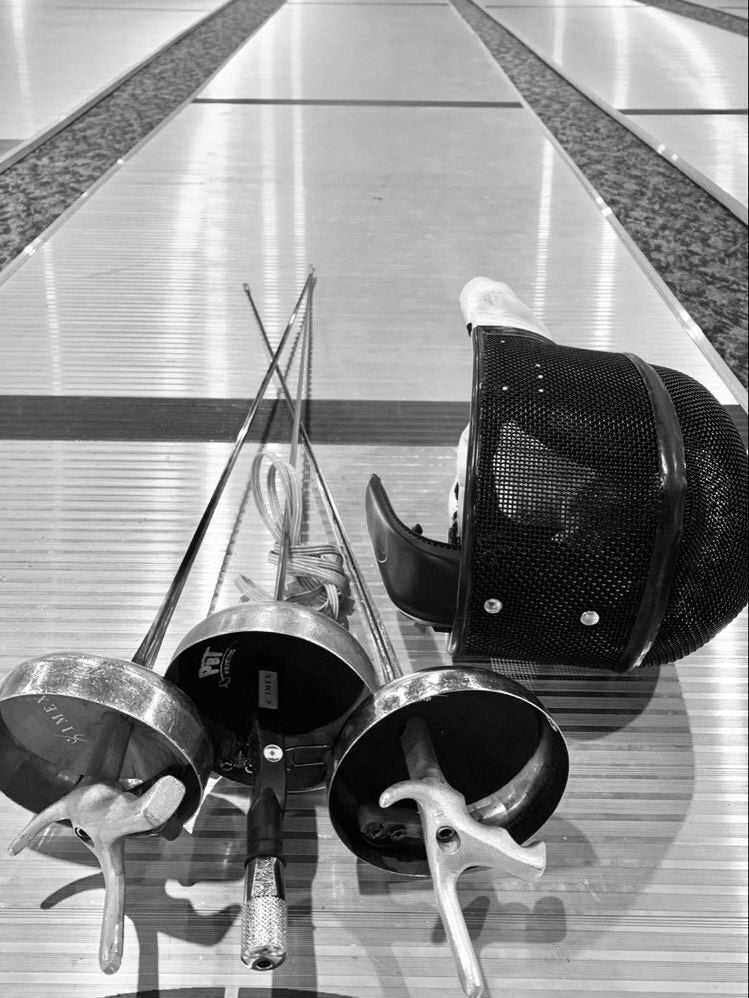
Why fencing?
If your 8-year-old just asked to try fencing — or you saw a class and wondered if it might be the right fit — read this first.
Most parents come to fencing the same way: their kid sees the Olympics on TV, watches a fencer in a sci-fi movie, or notices an after-school flyer. Then comes the obvious question — is this actually a good idea for an 8-year-old?
Twenty years of coaching beginners, including running fencing programs in NYC schools through Fencing in the Schools, has given us a clear answer: yes, with caveats. Here is the honest version.
It teaches focus most sports do not.
Fencing rewards the kid who slows down. The mechanics — distance, timing, reading the opponent — only work if you stop reacting and start thinking. We watch kids who could not sit still in a classroom calmly hold a stance for ten minutes during a private lesson. The sport pulls focus out of kids in a way the kids themselves notice.
It is safer than almost any other sport.
Concussion rates in fencing are statistically among the lowest in youth athletics — well below soccer, basketball, and football. Modern fencing masks meet CEN Level 1 puncture standards (350 Newtons), jackets and pants are designed to absorb thrust force, and the rules are designed around touch detection, not impact.
It is a college admissions advantage.
Fencing is recognized as one of the strongest sports for admissions to highly selective colleges — alongside crew, squash, and a handful of other niche sports. That advantage is not a guarantee, but for kids who commit to the sport through high school, it is real. Our alumni have competed for Notre Dame, Penn State, Columbia, Princeton, Harvard, Penn, and St. John's, among others.
It is an individual sport with team energy.
Bouts are one-on-one — your kid is responsible for their own performance. But practice happens in groups, the team feel at competitions is real, and the fencing community is one of the most supportive youth sports communities. Kids who do not love team-sport politics often find a real home in fencing.
It is not cheap, but it does not have to be expensive.
The honest cost: a starter kit (mask, jacket, glove, weapon) runs around $300-450. Group lessons at a club run $25-40 per session. Tournament entry fees are real but optional for the first few years.
That said: this is exactly the cost that Fencing in the Schools exists to remove. We bring fencing into public and charter schools so cost is not the reason a kid cannot try the sport. Morehouse Fencing Gear was founded for the same reason — top-level fencing gear at a lower price.